UIA Snapshot 2025: UMBC
STUDENT SUCCESS BENCHMARKS (2025 Outcomes)
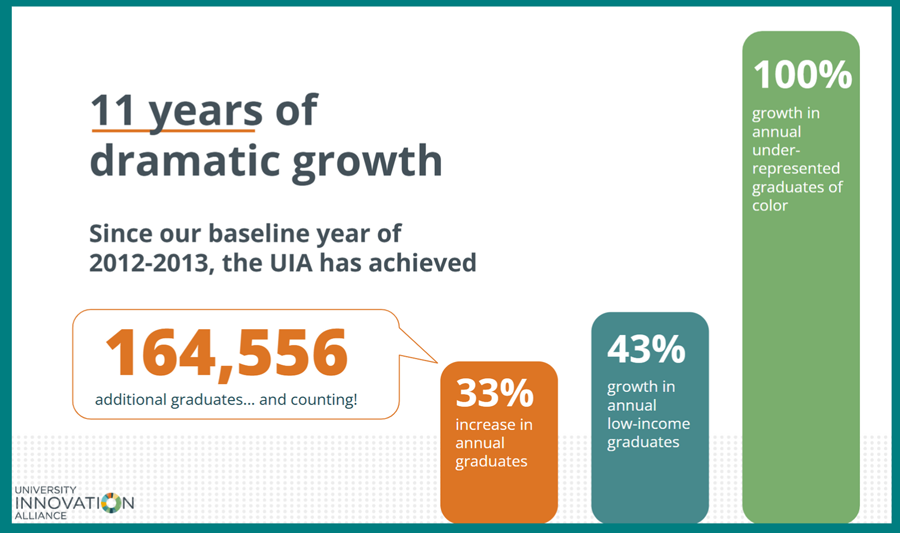
Overall graduates from UMBC had relatively flat growth in the first year after baseline (from 2020-21 to 2021-22), followed by declines, until 2024-2025, which saw a 4.8% increase from 2023-2024 (though still lower than baseline). There have been recent increases in the proportion of UMBC graduates who are underrepresented students of color and low-income graduates. Five-year and ten-year growth projections are anticipated due to larger fall incoming classes in 2021 and 2022 as well anticipated increases in the transfer population.
INNOVATION IN ACTION (2025 Project Participation)
Learning Innovations: Faculty Driven Classroom Interventions to prevent DFW rates
Purpose and Approach:
The Scaling Faculty-Led Innovation project was designed to strengthen institutional capacity for faculty-led teaching and learning redesign in high-impact and gateway courses.
What Happened at Scale:
- 7,000+ students reached, demonstrating higher attendance, improved pass rates, reduced anxiety, stronger confidence
- 13 campuses involved
- 55 faculty engaged
- 24 courses redesigned
UMBC Participation:
Faculty redesigned UNIV 301: Introduction to the University for Transfer Students to better support underserved male transfer students who were experiencing high DFW rates in STEM courses. The redesign introduced a targeted workshop on metacognitive learning strategies and restructured reflective journal assignments to help students develop stronger study practices, connect with academic supports, and build a greater sense of belonging.
Reported Outcomes:
- Faculty reported increased student awareness and use of proactive academic supports, including tutoring and campus learning resources.
- Students reported greater confidence and improved problem-solving approaches in STEM courses, with some noting improved exam performance.
Scaling Innovations in Higher Education Toolkit & Self paced eLearning Modules:
Higher education has long struggled with taking effective student success innovations to scale across institutions. This toolkit offers a practical, action-oriented resource for institutional leaders, governing boards, funders, policymakers, and change agents committed to enabling scalable, sustainable change.
Listening Lab: Elevating Student Voice
Purpose and Approach:
UIA’s Listening Lab initiative is aimed at fueling a transformative shift in how public research universities center student voice in institutional change. This two-year grant is designed to scale, institutionalize, and sustain empathy-centered listening practices across the UIA’s national network of campuses. The initiative builds on a successful pilot phase and is now expanding implementation of student focus groups across our network.
The primary goals of the grant are twofold:
1. Increase the number of campuses regularly engaging students through structured, qualitative methods that elevate lived experience as critical input
2. Support institutional and cross-campus strategic decision-making by translating these insights into concrete policy and program changes. The project aims to embed focus groups as a standard institutional practice, ensuring campuses have the skills, staffing, and support necessary to act on what they hear.
Project Metrics
- 12 campuses have listened to…
- 404 students across…
- 85 focus groups, and…
- 45 new moderators have been trained
UMBC Participation:
UMBC conducted a Listening Lab study to better understand how undergraduate and graduate students perceive and use Career Center services. Through six focus groups with 47 students, the team explored awareness, engagement, and barriers to access in order to identify strategies that improve outreach, ensure equitable access to career resources, and strengthen students’ career readiness. Findings centered on awareness of and engagement.
Key Insights & Outcomes:
- Without continued and tailored outreach, there is often a gap between initial awareness of Career Center services (often introduced at orientation) and sustained engagement throughout students’ academic careers.
- Specific student groups have distinct challenges related to their career search – e.g., humanities and arts majors, international students, commuter students, and early undergraduates. These student groups (among others) expressed a need for major-specific and identity-conscious career guidance.
- Communication channels strongly influence participation, with students preferring in-person announcements, physical signage, and concise, relevant messages over mass email outreach.
Professional Development, Experiences & Resources Provided by the UIA in 2025
2025 NOTABLE TOPICS:
General Education Reform Campus Experiences, Integrating Career Readiness into the Holistic Student Experience, Understanding the Concept of State Aligned Centers for the Future
- 13 Campus Liaison Community of Practice Experiences
Adaptability: Working Inside Institutional Reality, How Change Actually Happens, College Choice Landscape Analysis & Work Planning
- 23 Campus Fellows Community of Practice Experiences
AI Operational Efficiency and Effectiveness, Centers for the Future, & NISS Diagnostic Student Success Outcomes
- 4 Chancellor/President Community of Practice Experiences
University Healthcare Systems Leadership Discussion, Exploring Leadership Development/Community Needs of Leaders in the Provost Role
- 4 Provost Community of Practice Experiences
2025 RESOURCES PROVIDED:
The UIA paid for two large network convenings in 2025 and contributed more than $82K in travel expenses on behalf of member campuses to the Fall UIA Convening.
2025 FUNDRAISING SUPPORT:
In 2025, UIA secured $1.6M in new funding to support collective projects and convenings, advanced new fundraising concepts across four priority areas aligned to its revised goals, and distributed more than $735K in innovation project support to member campuses.
UMBC-Specific Support in 2025:
Center for the Future Concept Development: Working with President Sheares Ashby, UIA CEO built a concept for
Maryland 2050, to start discussions about Maryland’s future and establishing a state based center for economic competitiveness.
AI Decision Making Framework: This guide is a vendor diagnostic tool designed to help presidents, chancellors, and provosts assess enterprise AI agreements before they sign them. It focuses on what matters most at the point of decision: data use, governance, institutional risk, and long term control.
University Innovation Lab: 43 faculty/staff users from UMBC active in 2025. The UIA provided 8 facilitated learning cohorts in the lab in 2025.
LOOKING AHEAD TO 2026
Building Momentum and Working Collaboration Infrastructure on the following topics:
- College Choice Redesign Launch
- Chairs & Dean’s Leadership Academy Build
- Expanded Offerings for the Provost Community of Practice
- AI Enablement for Campus Operations
- Centers for the Future–State Leadership
- Active Fundraising to Support Network Innovation: $3M Target